Jelly Hole: Roll & Eat Pals
- 4.7
- Rating
- 5.00M
- Installs
- Free
- Price

 Analysis by App-foxy
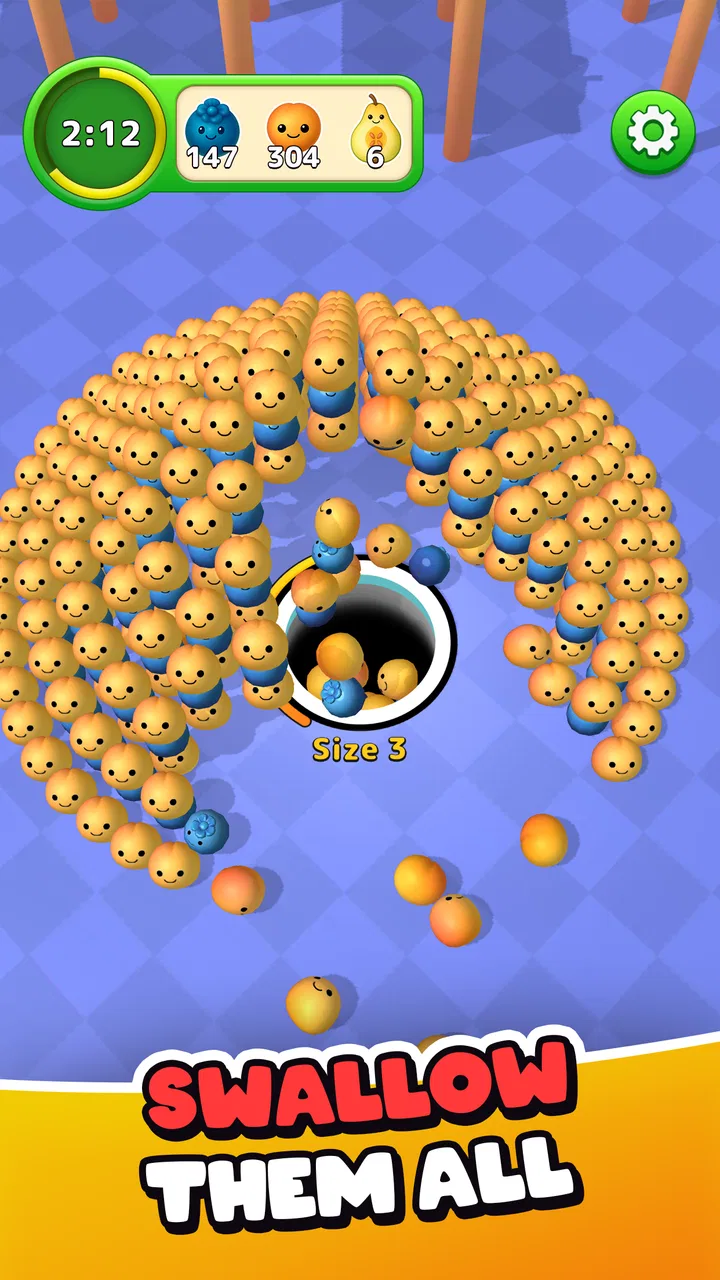
I spent time with Jelly Hole: Roll & Eat Pals as a quick arcade game, and its central idea is immediately easy to understand: guide a hungry jelly-like hole around a play area, collect food, and become large enough to swallow bigger targets. That simple loop is the whole appeal. It is approachable within seconds, works well in short sessions, and gives you a clear reason to keep moving even when you only have a few minutes.
What makes it worth discussing is not a complicated story or a deep collection system, but how well the basic movement-and-growth idea fits casual play. I found myself treating each round as a small challenge: start carefully, gather what is available, expand my options, and avoid wasting time on targets that are still too large. It is a familiar arcade formula, yet the food theme gives it a friendlier personality than many obstacle-focused alternatives.
How the eating loop feels in everyday play
The game belongs to the arcade category, and that description is accurate. The focus is on immediate control rather than long explanations, character dialogue, or a large world to learn. You steer the hole, look for edible objects, and use the resulting growth to reach more ambitious targets. The store summary highlights fruits and vegetables, and that gives the action a colorful, readable direction without requiring any background knowledge.
You May Also Like

 Pandora - Music & Podcasts
Pandora’s Music Is Easy to Start, but Harder to Recover
Pandora’s strength is its low-effort path from a seed to a station. Its weak spot is how much confidence it asks you to place in connection, setup, and quiet recovery.

 8 Ball Pool
 Is Built on Rivalries, Rematches, and Routine
A close look at the rivalries, rematches, shared routines, and unanswered safety questions that turn a quick pool match into a persistent mobile community.

 Samsung Music
’s Quiet Strength Is Playing What You Already Own
Its reach comes less from spectacle than from dependable access to a personal library. That simplicity is both the app’s strongest retention engine and its ceiling.

 AccuWeather: Weather Radar
AccuWeather Review: A Quick, Clear Forecast for Everyday Decisions
For everyday plans, the best forecast is the one you can understand quickly. AccuWeather makes rain timing, radar, and local conditions easy to act on, with a few trade-offs.

 Hill Climb Racing
Why Hill Climb Racing Still Turns Crashes Into One More Run
A tiny car, a bumpy hill and one more upgrade: Hill Climb Racing keeps resurfacing because its simple chaos makes every near-miss feel personal.

 AliExpress - Shopping App
AliExpress Makes Global Shopping Feel Personal, but Shoppers Bear the Risk
AliExpress turns a global marketplace into a pocket-sized discovery engine. Its reach is useful, its shopping loop compelling, and its trade-offs easy to miss.
More From Our News Desk
View All News


My first useful adjustment was learning not to chase the largest visible item straight away. The more reliable approach is to sweep through smaller food first, especially when it is positioned along a convenient route. That creates a rhythm of collecting, enlarging, and then returning to areas that previously seemed out of reach. It is a small tactical choice, but it prevents the game from becoming random wandering.
That makes the title more interesting than its one-line premise suggests. You are not simply moving toward whatever catches your eye. You are constantly judging whether a target is worth the detour, whether a route will leave you in a better position, and whether collecting nearby items will open up a more efficient path. The decisions are light, but they are present in nearly every session.
A realistic use case is a short break between tasks. If I have only a few spare minutes, I can start playing without remembering a complex control scheme or reconstructing a plot. The game suits that situation better than a traditional arcade title that demands a long uninterrupted run. It also works for younger players who want something visual and direct, although adults looking for a demanding competitive challenge may find the loop too gentle.
What the free price means in practice
The game is free to download, so the initial commitment is low. That matters here because the appeal depends heavily on whether you enjoy guiding the hole and repeating the growth cycle. I can try it without paying first, decide whether the movement feels comfortable, and only then consider whether any optional spending is worthwhile.
There are in-app purchases ranging from $0.99 to $99.99 per item. I would treat that range as a reason to be deliberate rather than as an automatic problem. Free access gives the game its strongest value for casual players, while the purchase options mean anyone who spends should check each item carefully before confirming. The important distinction is that the entry price and the possible spending are not the same thing.
For me, the sensible value test is simple: play enough free sessions to see whether the core loop remains enjoyable without relying on purchases. If the basic eating-and-growing routine already feels satisfying, the game can be a useful little arcade distraction at no initial cost. If it feels repetitive after a few attempts, paying will not solve that fundamental issue. I would not spend merely because a larger option appears on screen.
The game is listed for Everyone, which matches its approachable food-based presentation. That does not mean every child will find the controls equally easy, so I would still let a younger player try a session before assuming it is a perfect fit. For families, the free starting point is convenient, but purchase settings are worth handling thoughtfully on the device being used.
Small decisions that improve a run
The first practical tip is to think in routes rather than isolated targets. When several small items sit near one another, collecting them in one sweep is usually more useful than crossing the area for a single tempting object. The goal is to build size while preserving momentum. A route that looks slightly less exciting can produce a better position for the next part of the run.
The second tip is to use growth as a planning tool, not only as a reward. After becoming larger, I found it helpful to reconsider places I had already passed. A previously unreachable food item can become the anchor for the next route, and that can be more efficient than searching randomly for something new. This turns the play area into a sequence of opportunities instead of a flat field of collectibles.
The third trade-off is between speed and certainty. Moving quickly feels satisfying, but rushing toward a target can lead to awkward positioning or a wasted detour. When I slowed down briefly to line up a cleaner approach, the following collection phase often became easier. Players who enjoy perfecting a route will get more from this deliberate style than those who only want constant motion.
I also recommend treating the end of a run as a planning lesson rather than simply a failure or success. If I finished with several obvious items untouched, that usually indicated poor route selection rather than a control issue. Remembering where the run became inefficient made the next attempt more focused. This is one of the few ways to create personal progression when the underlying mechanics are intentionally simple.
Where it differs from familiar arcade alternatives
Compared with reflex-heavy arcade games, this one places more emphasis on spatial judgment and gradual expansion. It is less about tapping at exactly the right instant and more about deciding where the hole should travel next. That makes it approachable for players who enjoy movement and collection but do not want a constant stream of precision challenges.
Compared with endless runners, the experience is also more exploratory. An endless runner usually pushes you forward and asks you to react to hazards, while this game gives the eating objective more importance. I prefer Jelly Hole when I want to make small route choices at my own pace. I would choose an endless runner instead when I am specifically looking for escalating speed, reflex pressure, and a score-chasing rush.
It is not the best replacement for a puzzle game either. There is some planning, but the decisions remain quick and physical rather than deeply analytical. Someone who wants layered logic, elaborate level solutions, or a long-term strategic system should look elsewhere. The strength here is the immediate satisfaction of becoming capable of swallowing more of the environment.
The developer is SayGames Ltd, and the game’s presentation follows the compact, accessible style I would expect from a mobile arcade release. Its average rating is 4.6 from around 48 thousand ratings, with over a million installs. Those figures suggest that the straightforward concept has found a sizeable audience, but they do not replace personal testing: the same simplicity that attracts casual players may disappoint anyone expecting a more substantial game.
Who will get the most from it
I think the best audience is someone who likes short, repeatable sessions with visible progress inside each attempt. The game gives you a clear immediate objective and does not ask you to understand a large rulebook before having fun. It is particularly suitable for players who enjoy collecting objects, improving routes, and watching a small character or shape grow more capable.
It can also work as a low-pressure introduction to arcade games. The food theme is easier to approach than a combat-focused setting, and the Everyone rating supports that broad accessibility. Parents or guardians should still remember that free games with in-app purchases deserve sensible device-level purchase controls, especially when children can access the screen.
I would skip it if your main priority is a rich narrative, multiplayer competition, or a game that changes dramatically from one session to the next. The core attraction is repetition with gradual mastery. If you dislike revisiting the same kind of movement-and-collection challenge, the friendly presentation will not hide that limitation for long.
I would also be cautious if you are looking for a completely purchase-free experience. The game can be started for free, but the presence of items priced from $0.99 to $99.99 means the spending environment should be part of your decision. My advice is to enjoy the basic loop first and regard every purchase as optional rather than necessary for deciding whether the game itself is fun.
Device fit and what to expect from the current release
The minimum operating-system requirement is Android 8.0, which makes the game accessible to a broad range of Android devices that are still in regular use. The current version is 1.15.0. I would still keep expectations realistic: compatibility does not guarantee identical comfort on every phone, and the quality of the experience will depend on how responsive movement feels on the particular screen.
Because the game relies on direct steering and visual positioning, control response matters more here than it would in a mostly menu-based app. If movement feels imprecise on your device, the route-planning side becomes frustrating even when your decisions are sound. I would test several short runs before judging the game’s difficulty, since an unfamiliar control feel can initially seem like a gameplay problem.
The release date is Jun 6, 2025, so this is a relatively recent arcade offering rather than an old title being rediscovered. That is useful context for anyone deciding whether to try it now, but I would base the decision mainly on the present loop, the free entry point, and your tolerance for repetition. A newer release is not automatically deeper or better suited to your habits.
My value judgement after playing
The strongest value comes from the combination of free access and a loop that explains itself quickly. I can recommend it to a friend who wants a cheerful arcade game for brief breaks, especially if that friend enjoys mapping out efficient collection routes instead of chasing complicated objectives. The game earns its place as a casual time-filler because it gives each run a clear beginning, a visible growth goal, and an obvious reason to try again.
The limitations are equally clear. The concept is narrow, and its success depends on whether swallowing food and expanding remains entertaining after the novelty fades. It does not offer the same kind of depth as a dedicated puzzle game, the same urgency as a reflex runner, or the same social motivation as a competitive multiplayer title. Those are not flaws in the intended format, but they are important boundaries for a potential player.
My practical recommendation is to download it free, play without spending, and pay attention to how often you genuinely want another run. If you naturally start planning better routes and trying to improve your collection, it is delivering enough value for your style of play. If you are already reaching for another game after only a few attempts, keep your money and choose an arcade alternative with stronger variety or more demanding goals.
In the end, I see Jelly Hole: Roll & Eat Pals as a pleasant, focused arcade game rather than a major all-purpose mobile experience. Its best quality is the clean connection between movement, eating, and growth: every successful route makes the next target feel possible. For free, it is easy to try and easy to recommend to casual players; for paid extras, I would be selective and never treat them as a requirement. That makes it a good short-session choice, provided you want a simple loop and understand exactly where its depth ends.
FAQs for Jelly Hole: Roll & Eat Pals
01What is the main objective of Jelly Hole: Roll & Eat Pals?
The main goal of Jelly Hole: Roll & Eat Pals is to navigate a jelly-like character through various levels, consuming smaller pals to grow in size while avoiding obstacles and enemies. Players need to strategize their movements to maximize growth and successfully complete each level to progress.
02Is Jelly Hole: Roll & Eat Pals free to play, or are there in-app purchases?
Jelly Hole: Roll & Eat Pals is free to download and play. However, it offers in-app purchases that can enhance the gaming experience. These purchases may include additional lives, power-ups, or cosmetic items. Players can enjoy the game without spending money, but purchases can help advance more quickly.
03What devices are compatible with Jelly Hole: Roll & Eat Pals?
Jelly Hole: Roll & Eat Pals is available for both Android and iOS devices. It requires Android version 5.0 or higher and iOS 11.0 or later. The game is optimized for smartphones and tablets, providing a smooth experience on a wide range of devices.
04Does Jelly Hole: Roll & Eat Pals require an internet connection to play?
Jelly Hole: Roll & Eat Pals can be played offline, offering a seamless gaming experience without the need for an internet connection. However, some features like in-app purchases and leaderboards may require connectivity. Players can enjoy most of the game’s content while offline.
05Are there any ads in Jelly Hole: Roll & Eat Pals?
Yes, Jelly Hole: Roll & Eat Pals includes ads that appear occasionally during gameplay. These ads help support the developers and allow the game to be free to play. Players can choose to remove ads through a one-time purchase if they prefer an uninterrupted gaming experience.
Pros
- Addictive gameplay with simple controls.
- Vibrant graphics enhance user experience.
- Challenging levels increase replayability.
- Smooth performance on most devices.
- Regular updates with new features.
Cons
- Can become repetitive over time.
- In-app purchases can be pricey.
- Requires internet for some features.
- Ads may interrupt gameplay frequently.
- Limited customization options.

Jelly Hole: Roll & Eat Pals
Gallery